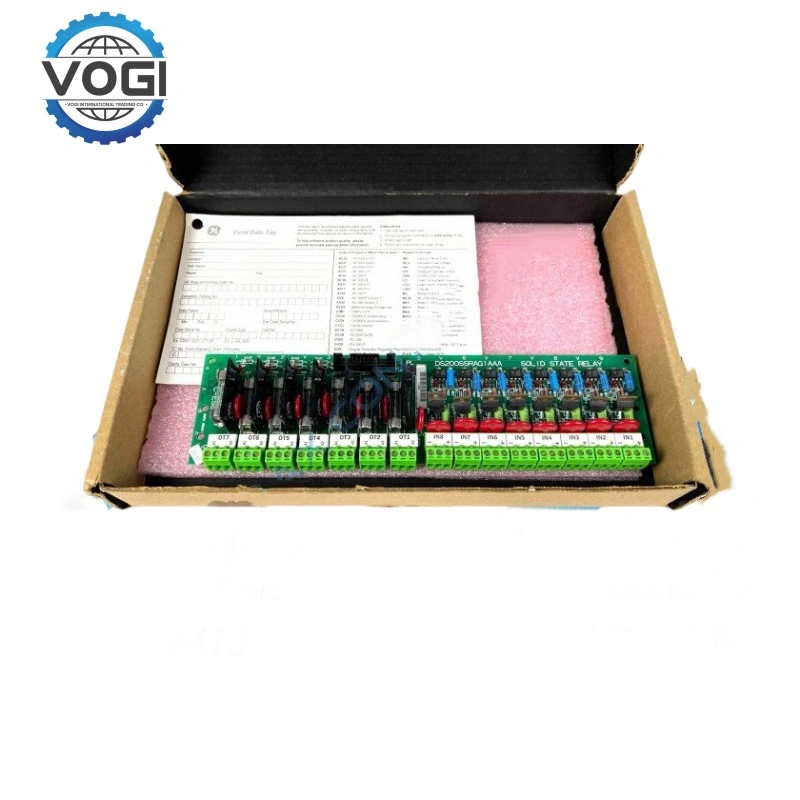
GE IC695CRU320
| Brand | GE |
| Module Number | IC695CRU320 |
| Unit price | $4999 |
| Country Of Origin | USA |
| Weight | 0.75KG |
| Certificate |
C/O from the Chamber of Commerce C/Q from the Manufacturer |
| Warranty | 12 Months |
| Inventory Qty | 2 |
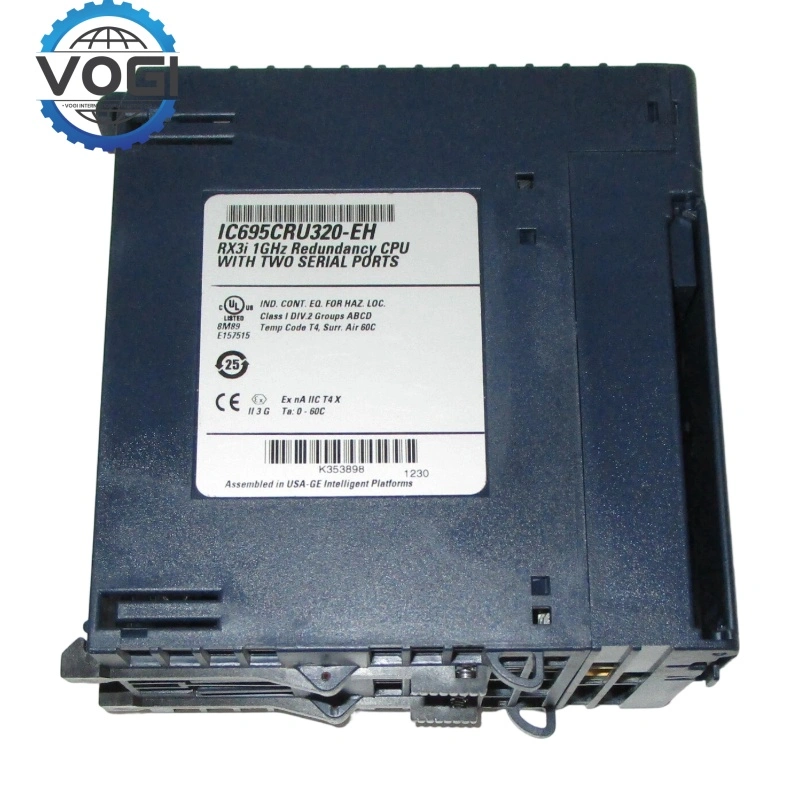
GE IC695CRU320 is redundancy CPU and it is belong to PACSystems RX3i series. It is used to perform real time control of machines and so on.
IC695CRU320 is CPU, but it is redundancy CPU belong to GE Fanuc(now is EMERSON) RX3i. When the main CPU fails, the backup CPU seamlessly takes over, with the switching time ranging from 3.133ms to 1 scan cycle. There is no disruption to the process and it is a seamless switch. This is the greatest advantage of the redundant CPU.
Similar CPU model like this
IC695CPU310 IC695CPU315 IC695CPU320 IC695CPU330 IC695CPE330 IC695CPE400
Here is the parameters of IC695CRU320
1GHz Celeron-M processor, 64MB flash memory + 64MB battery-backed RAM
Dual serial ports:RS-232/RS-485
Supporting protocols: SNP, Modbus
Can be expanded with Ethernet and PROFINET.
Account Number 88800006406771
Account name Vogi International Trading Co., Limited
(* If the account name exceeds the available space, please continue in the address field.)
SWITF/BIC Code WIHBHKHHXXX
Bank name OCBC Hong Kong Branch
Bank address 161 Queen's Road Central, Central, Hong Kong
Country/Region Hong Kong (China)
Account type Business Account
Bank code 035
Payment method For the payment of goods, please make a FPS/CHATS/SWIFT Payment
Notes Please include the following memo/message to receiver when making a payment: [Buyer Name] [Invoice/Contract Number] [Product]
What is the difference between Redundance CPU and CPU
The simplest explanation is that an ordinary CPU works alone and stops operating when it breaks down; while a redundant CPU functions in a dual-person relay manner, with one failing, the other seamlessly takes over without causing a shutdown.
There is essentially no difference in the on-site usage. The only requirement is that redundant CPUs must be used in pairs, and other supporting modules must also be combined in pairs to form the entire system.
However, there are still some differences in terms of functional capabilities. The following are some of the items for comparison.
|
Comparison item |
Ordinary CPU |
Redundant CPU |
|
Operating Architecture |
Standalone Server |
Dual-server hot standby with mutual backup |
|
Fault consequences |
Complete shutdown |
Seamless switching without downtime |
|
Data synchronization |
Unidirectional master-slave synchronization |
Program, registers, I/O real-time mirroring |
|
Online maintenance |
Not supported |
Online module replacement is supported |
|
Scan switching |
No switching function |
Complete seamless switching within one scan cycle |